The record, as it stands
Current diagnoses, medication, what changed since the last visit, what has been flagged — pulled from the source systems over FHIR.

How we read the product, how we would build it,
and what each phase takes.


A general physician has a few minutes before a patient walks in, and the record system was not built for those minutes. Clinexus assembles the patient into one screen — read from the record, never written back to it.
Current diagnoses, medication, what changed since the last visit, what has been flagged — pulled from the source systems over FHIR.
Source and date travel with each value. A clinician can see where a number came from and how old it is without leaving the screen.
It answers from the patient's data, cites what it used, and abstains when the record does not support an answer.
Alerts are read from the source system, not computed here. "Start Visit" and "Reschedule" stay local. Referrals are read-only.
This is the reading your answers of 28 July put us on, and every figure later in this deck rests on it. Where your designs point somewhere else, we have said so — in the scope document rather than in week six.
 02
02The pilot and V1.0 are not two products. They are the same shape, with V1.0 adding services underneath the screens rather than replacing them.
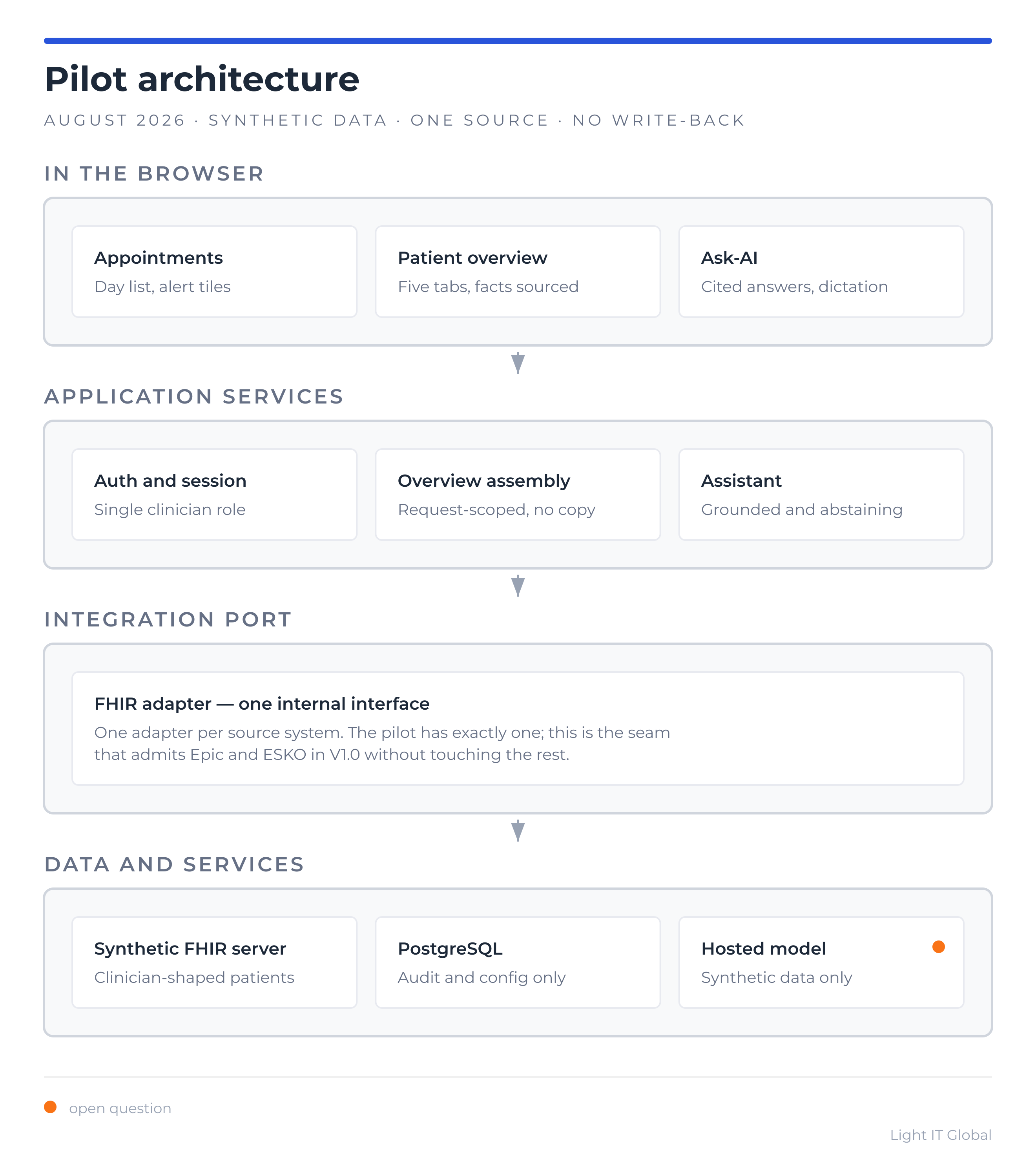
The day's list, the patient overview, the assistant. This is where the pilot's weight sits — most of its effort is here.
Assembly, provenance, session and audit. It owns the rule that a fact never loses its source.
The assistant and the model sit behind one interface from day one, so the model can be swapped, pinned or moved inside a boundary without touching the screens.
One internal interface, adapters behind it. FHIR stops at the port; nothing above it knows which system the data came from.
Why this matters for the estimate. The pilot buys layer 1 over a single synthetic source. V1.0 buys the depth of layers 2–4 — which is why it costs several times the pilot while looking, on screen, much the same.
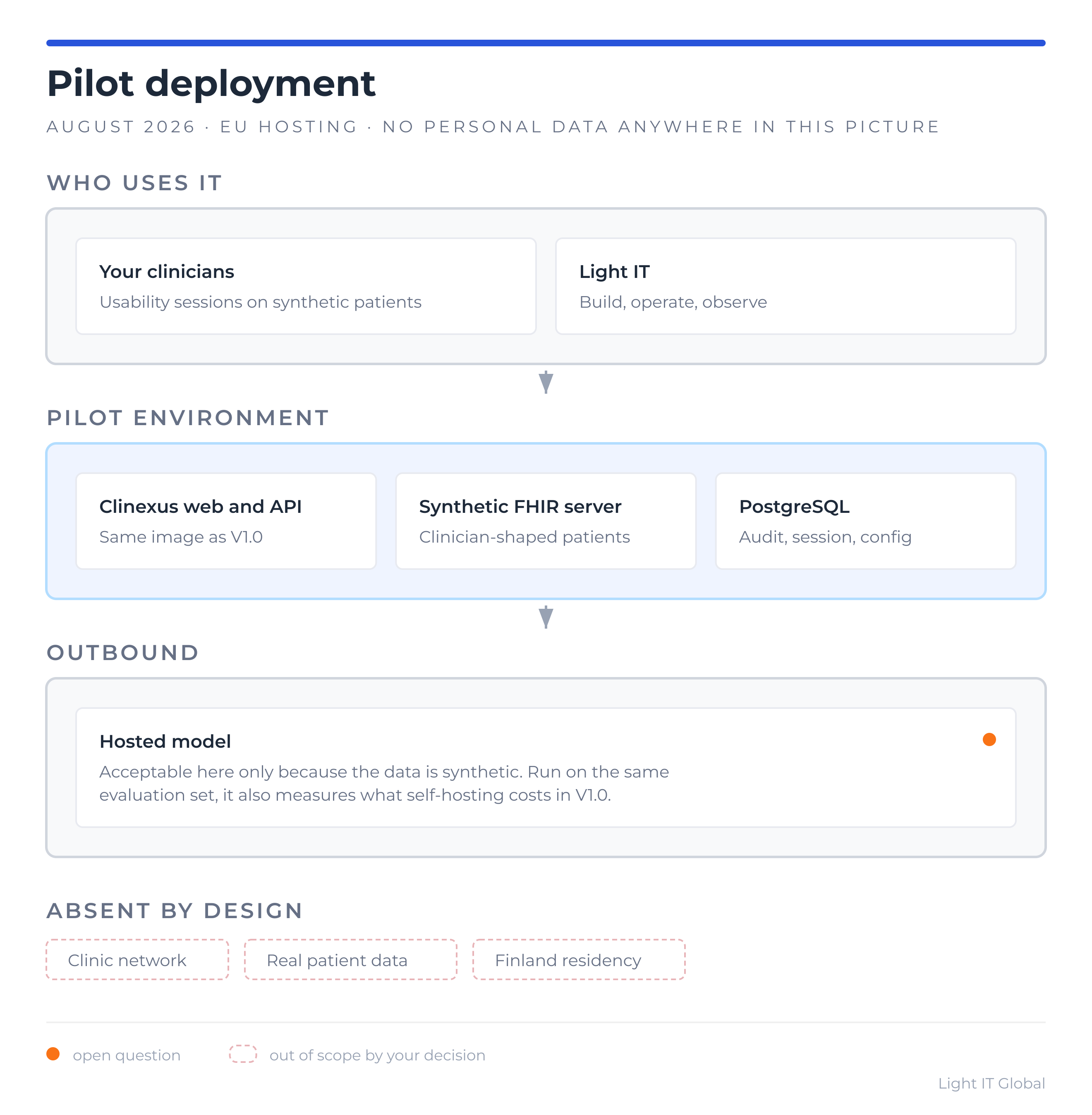
03Nothing in it waits on access to a system somebody else controls. That is what makes August reachable.
 04
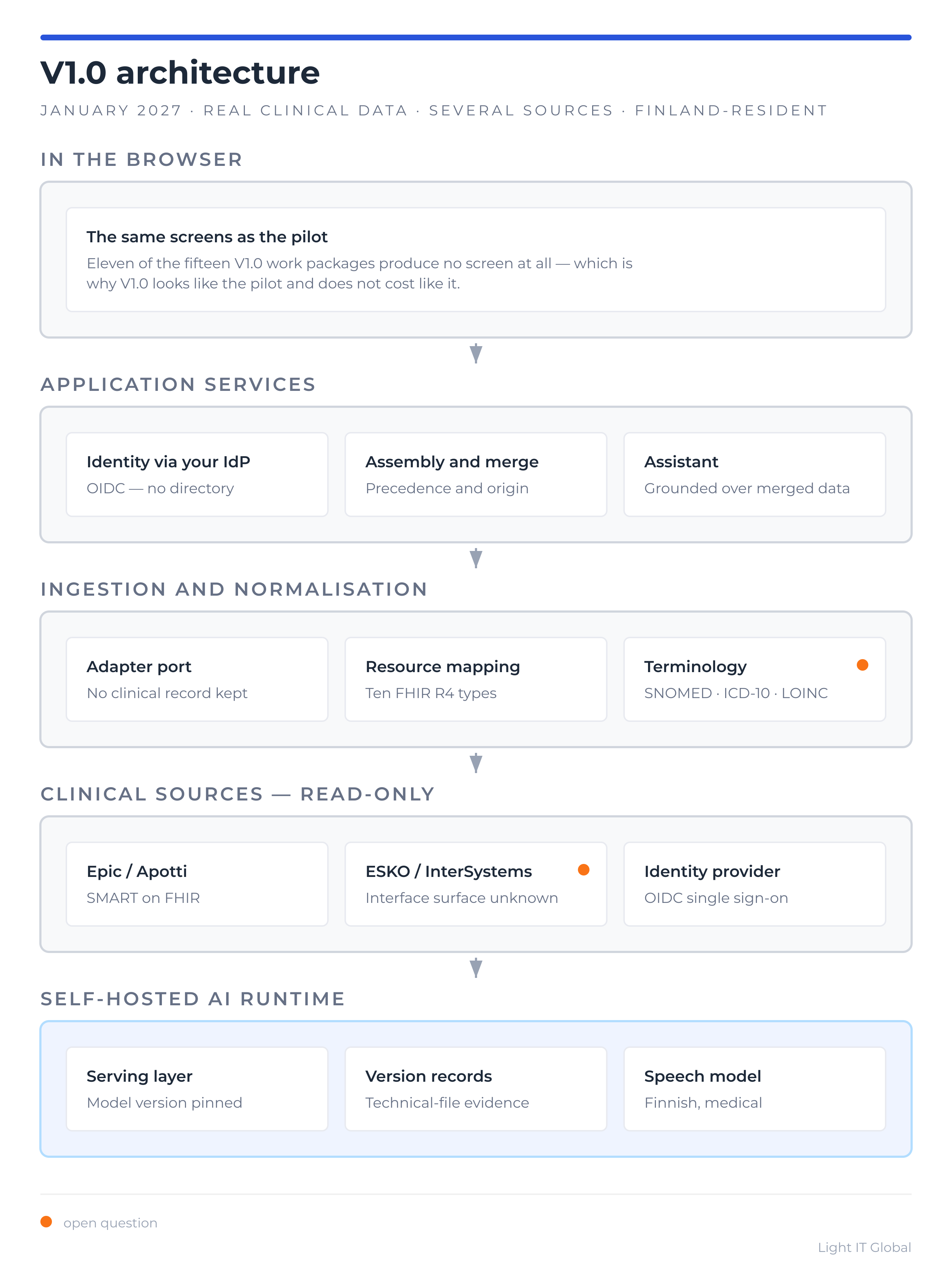
04Ingestion, adapters, aggregation, an inference runtime inside Finland, and a regulatory file. Most of what is added renders nothing on screen.
 05
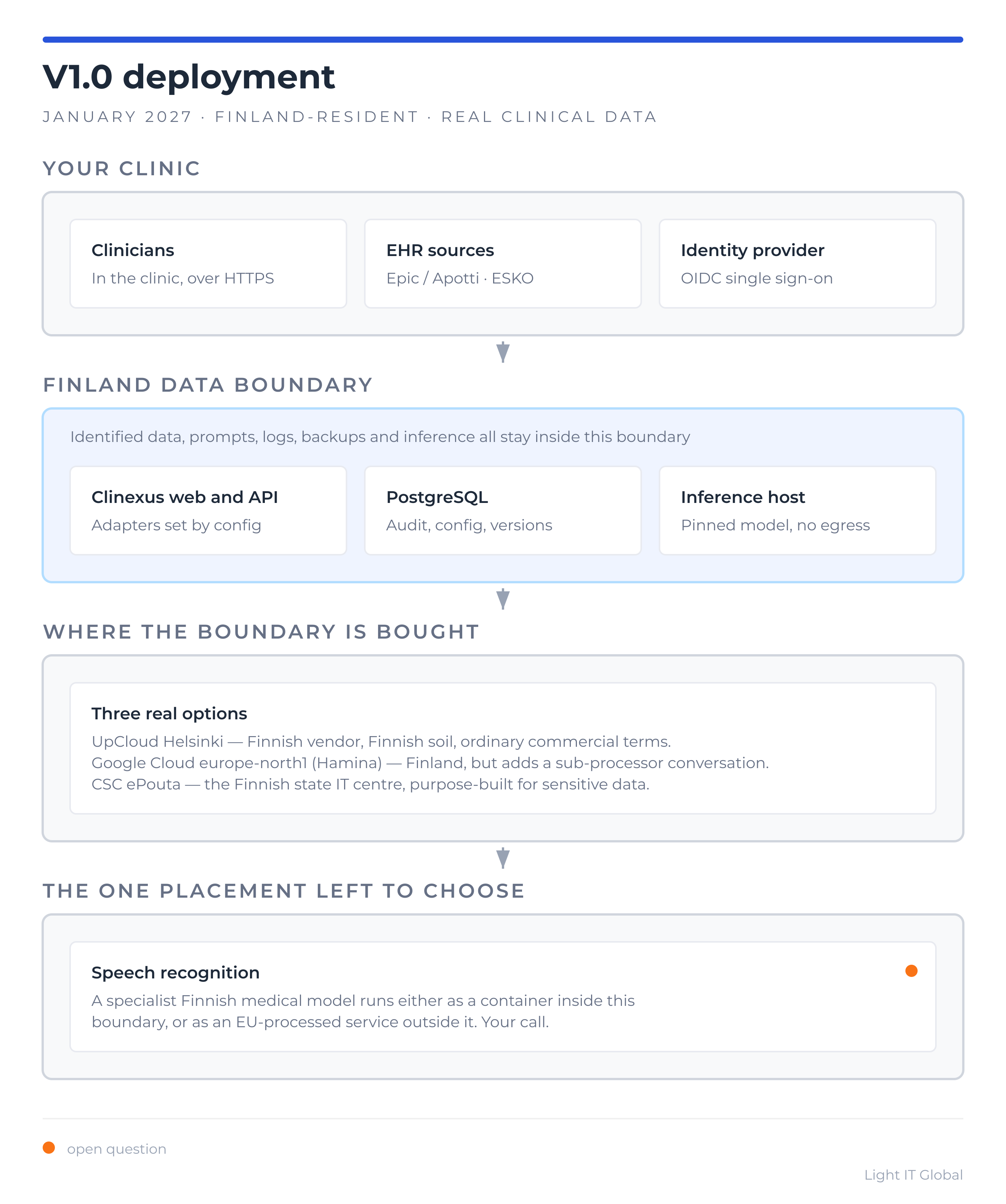
05Self-hosted inference in Finland means the model must be one we can download, pin to a fixed version and run inside your boundary. That rules out every hosted-only model — including most of the names at the top of today's leaderboards.
Licence first — several widely used families carry acceptable-use terms that read badly against a clinical device. Then serving size: one clinic of GPs is a modest load, and a single continuously running GPU in a Finland region — of the order of €800 a month at today's prices — covers it.
That is a third-party running cost rather than anything we charge, and it is worth carrying into your funding conversations as such.
A Nordic medical model that deploys as a container inside your boundary, or a Finnish healthcare specialist already used in wellbeing-services counties, processed in the EU.
Which one fits depends on how strictly self-hosting binds the speech component.
The pilot runs on synthetic data, so residency does not bind it and the model can be an external service. The Finland runtime is bought before the first identified patient record exists — not before August.
One question back to you. Your answer says self-hosted in Finland. We would like to hear what self-hosted means on your side — a container in a Finnish region, a machine you own, or a Finnish provider under contract. The three have different costs and different technical-file consequences.
06A first version, focused on the frontend and on usability testing, run with the doctors who made your synthetic data, on a tight timeline. We agree — and that is exactly the shape we have costed.
Working the full question list to the bottom before starting would take at least two weeks of both our teams — and August is the month you wanted the pilot in.
We would rather start on what is already settled and close the rest alongside it.
Synthetic data in FHIR R4, which you have. One or two hours with a clinical lead at kickoff. A decision on dictation. Nothing that waits on funding or on system access.
07A working product on synthetic data, in front of your doctors — not a prototype and not a click-through.
| Who is on it | Hours | FTE | W1 | W2 | W3 | W4 | W5 |
|---|---|---|---|---|---|---|---|
| Backend and integration | 180 | 0.90 | 40 | 40 | 40 | 40 | 20 |
| Frontend | 125 | 0.63 | 25 | 25 | 25 | 25 | 25 |
| QA | 85 | 0.43 | 15 | 15 | 15 | 20 | 20 |
| Project manager | 75 | 0.38 | 15 | 15 | 15 | 15 | 15 |
| Platform and DevOps | 32 | 0.16 | 20 | 12 | · | · | · |
| Architect · SA/TL | 25 | 0.13 | 5 | 5 | 5 | 5 | 5 |
| The team | 522 | 2.61 | 120 | 112 | 100 | 105 | 85 |
Five weeks, twenty-five working days, 2.6 full-time equivalents. Hours per role per week rather than one number, because the shape is the part you can check — and frontend is what paces this phase. We can start now: nothing in the pilot depends on the questions still open for V1.0.
08A single number here would be useless to you: it would be one you cannot act on until the whole round has closed. So it is cut into five parts, each of which delivers something that works on its own.
| Tranche | What it buys | Person-days |
|---|---|---|
| Product | The application itself — screens, assistant, notes, oversight, localisation, administration | 136–217 |
| Integrations | Adapters to your source systems, clinic identity, and the discovery that has to run against a real one | 26–44 |
| Finland AI runtime | The self-hosted model and speech recognition, and the Finland-resident environment they run in | 46–73 |
| Discovery | Answers bought before the work they gate. Decline any of them and the assumption it would have replaced stays yours | 7–8 |
| Regulatory | Our contribution into the technical file you own — hazard analysis, the evaluation gate, the software inventory | 29–47 |
| Clinexus V1.0 | 243–388 |
Read this as an orientation, not a commitment. Three of the five parts depend on answers nobody has yet — which source systems, which FHIR profile family, whether ESKO is available. Fixing a price against unknowns means pricing the unknowns, and you would be paying for our uncertainty. The range narrows as the open questions close, and those are what the accompanying material is for.
09None of the four needs a meeting. The decision is whether August still holds.
Does August still hold on your side, and are you in a position to start the pilot now? We are — the pilot has no dependency left that we control.
Everything we read, every divergence with the evidence on both sides, and the screens your designs imply but do not draw — kept out of this call on purpose, sent as material you can read at your own pace.
light-it.net
10